The first time I sat down to a full Onam Sadya, I had no idea what half the leaf was for. Someone poured a thin yellow curry over my rice before I’d even picked up a spoon, there was a pale green stew I couldn’t name, and by the time the payasam arrived I’d already filled up on the wrong things in the wrong order. I’ve eaten enough Sadyas since — at restaurants across Bangalore and a few home-cooked versions at friends’ places — to have a working map of the banana leaf now, and this is the guide I wish someone had handed me before that first meal.
Key Takeaways
- A traditional Onam Sadya can run from around 15 dishes to 26 or more, depending on the household or restaurant, all served together on a single banana leaf.
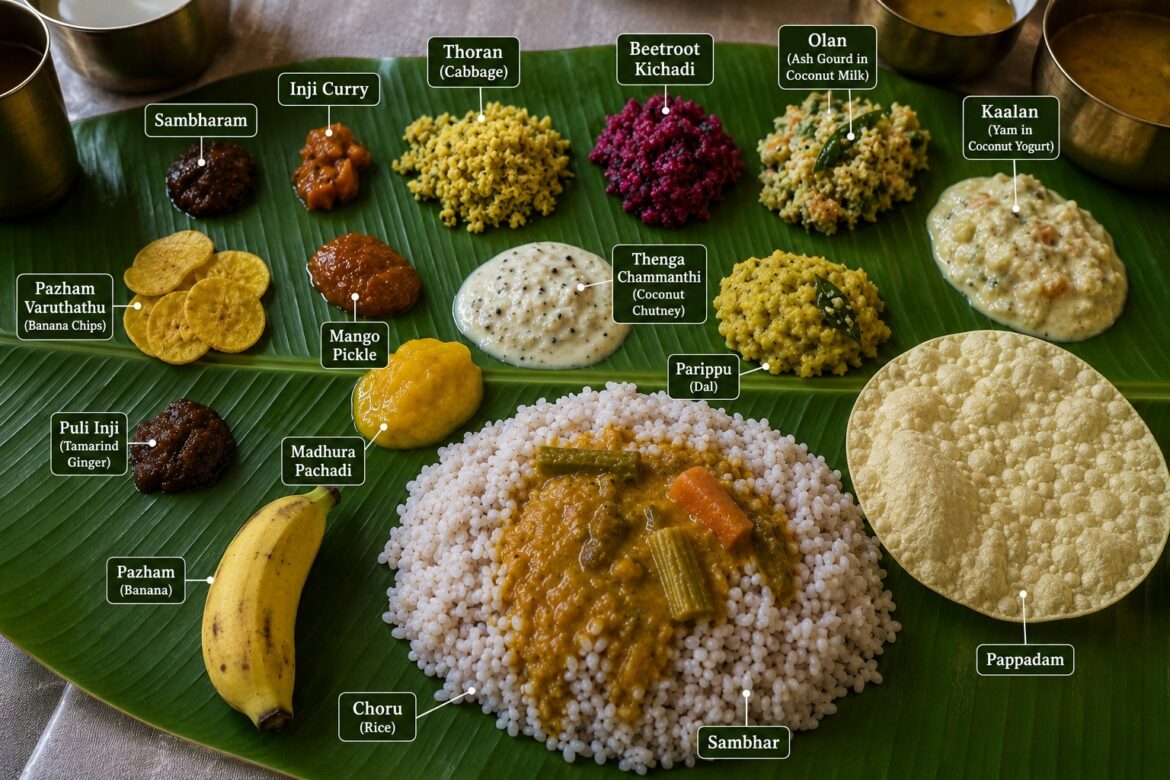
- The banana leaf has a set orientation — narrow tip to your left, broad end to your right — and dishes are placed in a fairly consistent pattern: rice and curries in the lower half, pickles and chips near the top.
- There’s a loose eating order: rice with parippu and ghee first, then sambar, then the vegetable curries, working toward rasam and payasam near the end — though most people mix and repeat rather than eating strictly in sequence.
- Payasam is the sweet closer, and a Sadya often includes two or more varieties, not just one.
- Pairing this with where to actually get one? Here’s my Bangalore Onam Sadya guide.
The Banana Leaf, Explained
Before the food, the leaf itself has rules, and it’s worth knowing them so you don’t feel like you’re guessing at a restaurant. It’s placed lengthwise with the narrow, tapered end to your left and the broader end to your right. A little water gets sprinkled over it first, which is a small purification gesture rather than a washing step — you don’t need to wipe it down yourself. Once you’ve eaten, folding the leaf toward you signals you enjoyed the meal; folding it away from you is the polite way to say you didn’t. I didn’t know this for years and have almost certainly sent the wrong signal at least once.
The Dishes, In the Order You’ll Generally Meet Them
| Dish | What It Is | Where It Sits / When You Eat It |
|---|---|---|
| Rice (usually Kerala matta rice) | The base of the whole meal, reddish and slightly nutty | Centre of the leaf, arrives first |
| Parippu | Cooked yellow lentils, usually finished with a spoon of ghee | Poured over the first serving of rice |
| Sambar | Tamarind-based lentil and vegetable stew, heartier than the North Indian version | Mixed into rice after parippu |
| Rasam | Thin, peppery, tamarind-based soup | Usually comes later, meant to aid digestion |
| Avial | Mixed vegetables in a thick coconut-curd gravy with curry leaves | Considered the signature dish of the Sadya — a Sadya without avial isn’t really a Sadya |
| Olan | Ash gourd and black-eyed peas in a light, mild coconut milk | One of the gentlest, least spiced dishes on the leaf |
| Kaalan | Yam or raw banana in a thicker, sourer coconut-yogurt gravy | Often confused with olan by first-timers — kaalan is tangier and heavier |
| Thoran | Stir-fried vegetable (commonly cabbage or beans) with grated coconut | Dry side dish, not a curry |
| Erissery | Pumpkin and lentils cooked with coconut, often topped with a coconut-mustard tempering | A slightly sweet, comforting curry |
| Pachadi / Kichadi | Vegetable or fruit in a sweetish or tangy yogurt-based preparation | A cooling counterpoint to the spicier curries |
| Inji puli | Ginger and tamarind reduced into a dark, sweet-sour-spicy paste | Small quantity, meant to aid digestion — don’t mistake it for a chutney to eat in bulk |
| Pickles | Usually mango or lime, sharp and salty | Small portions near the top edge of the leaf |
| Banana chips / Sharkara varatti | Crisp banana chips, plus a jaggery-glazed sweet version | Often the first things placed on the leaf, before the hot dishes arrive |
| Papadam | Thin, crisp lentil wafer | Eaten alongside rice, sometimes crumbled in |
| Payasam | Sweet, milk or coconut-milk based dessert, several varieties | Served last, sometimes more than one kind |
The Dish People Get Confused About Most
If there’s one pairing that trips up almost everyone new to a Sadya, it’s olan and kaalan. Both are coconut-based, both are yellowish, and both show up close together on the leaf. Olan is the gentler of the two — thin, mild, barely spiced, built around ash gourd. Kaalan is thicker, sourer, and built around yam or raw banana in a yogurt-coconut base with a stronger tang. I’ve learned to taste a small spoon of each before committing rice to either, since guessing wrong isn’t a disaster, just a slightly confusing bite.
Eating It: A Loose Order, Not a Strict One
The order isn’t a rulebook so much as a rhythm most people follow. Rice with parippu and a spoon of ghee typically opens the meal, since it’s mild and sets a base. Sambar comes next, mixed into another round of rice, followed by the vegetable curries — avial, olan, kaalan, erissery — which you can genuinely eat in whatever order or combination you like, since they’re all designed to sit alongside rice rather than in strict sequence. Rasam tends to come later, partly as a digestive palate-cleanser before the sweet finish. Payasam closes things out, and if there’s more than one variety, most people work from the lighter one to the richer one.
What nobody tells first-timers is that repeating dishes is completely normal — going back for a second helping of avial or asking for more sambar isn’t considered excessive, it’s part of how the meal is meant to be eaten. I spent my first Sadya rationing myself out of politeness and left having barely touched half the leaf.
A Few Things I’d Tell a First-Timer
Pace yourself early. The chips, pickles, and papadam arrive first and are easy to overeat before the real volume of the meal — the curries and rice — has even started. Don’t skip inji puli assuming it’s a garnish; it’s meant to be eaten in small, deliberate amounts through the meal, not once at the start. And don’t fill up before the payasam — it’s not an afterthought, and most people I know consider it the actual highlight of the meal, not just a polite ending.
FAQ
How many dishes are in a traditional Onam Sadya?
It varies by household and restaurant, but a full traditional spread typically runs from around 15 to 26 or more dishes, all served together on one banana leaf.
What’s the difference between olan and kaalan?
Olan is a light, mild coconut-milk stew built around ash gourd. Kaalan is thicker and tangier, made with yam or raw banana in a yogurt-coconut base. They’re easy to mix up on sight but taste quite different.
Is Onam Sadya vegetarian?
Yes, it’s entirely vegetarian, built around rice, lentils, coconut, and seasonal vegetables.
What order should I eat an Onam Sadya in?
There’s a loose customary order — rice with parippu first, then sambar, then the vegetable curries, working toward rasam and payasam — but it’s flexible, and going back for seconds of any dish is normal, not impolite.

Rohini writes about home styling, beauty, fashion, food, and travel from Bangalore, India — drawing on her background in interior styling and years of testing what actually works in real homes and everyday routines. Every recommendation here comes from something she’s personally tried, not aggregated advice.