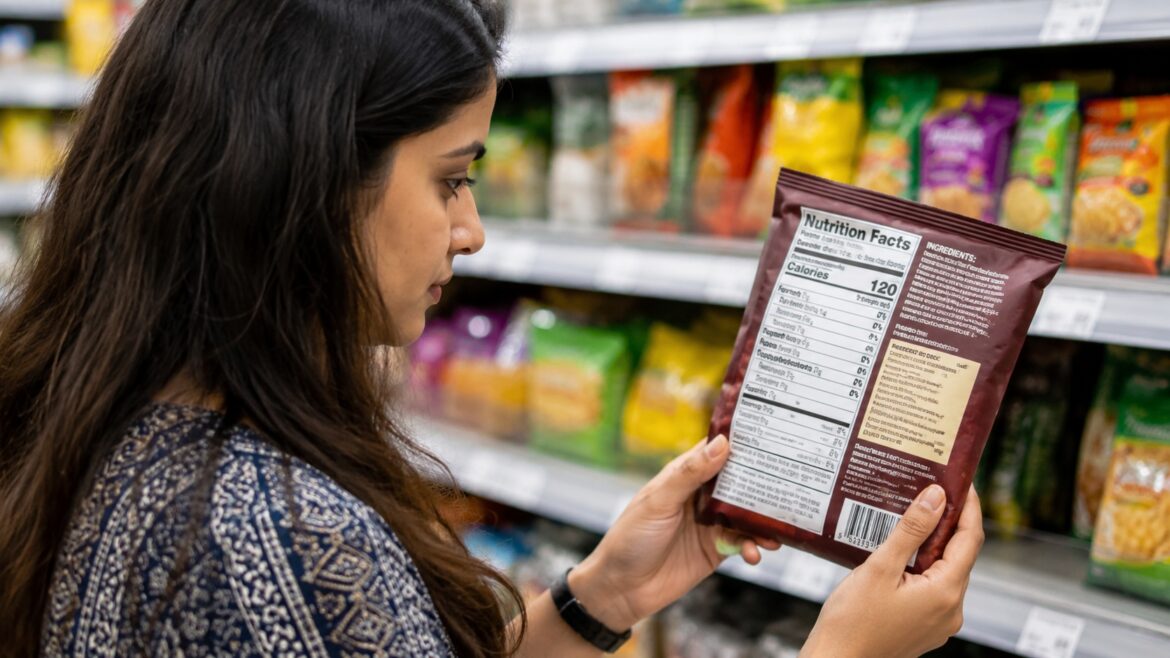
I used to be one of those people who checked the calorie number on a nutrition label and put the package back on the shelf. It wasn’t until I started looking at the serving size, sugar, sodium, and ingredient list that I realized how different the numbers on the back could be from the claims on the front.
A label that says “low fat” or “natural” doesn’t necessarily tell you whether a product is a good choice for your diet. The nutrition facts and ingredient list provide much more useful information — if you know what to look for.
The good news is that you don’t need to understand every number on the package. With a few simple checks, you can learn to read most nutrition labels in about 30 seconds.
To read a nutrition label, start by checking the serving size and number of servings, then look at calories, % Daily Value, sugar, sodium, and fat. Finally, scan the ingredient list, which lists ingredients by weight from highest to lowest. When comparing packaged foods in India, check both the per-serving and per-100g/100ml values where provided.
Key Takeaways
- Start with the serving size: Every nutrition value is based on the stated serving size, so check how much you’re actually likely to eat.
- Use % Daily Value as a quick guide: As a general rule, 5% DV or less is considered low, while 20% DV or more is considered high for a nutrient.
- Check sugar and sodium: Compare these values with the serving size and, when available, look at added sugars separately from total sugars.
- Read the ingredient list: Ingredients are listed by weight, from the greatest amount to the least. The first few ingredients can tell you which ingredients make up the largest share of the product.
- Compare products using the same quantity: When shopping in India, comparing nutrition values per 100g or 100ml can make it easier to compare similar products with different serving sizes.
Start With Serving Size
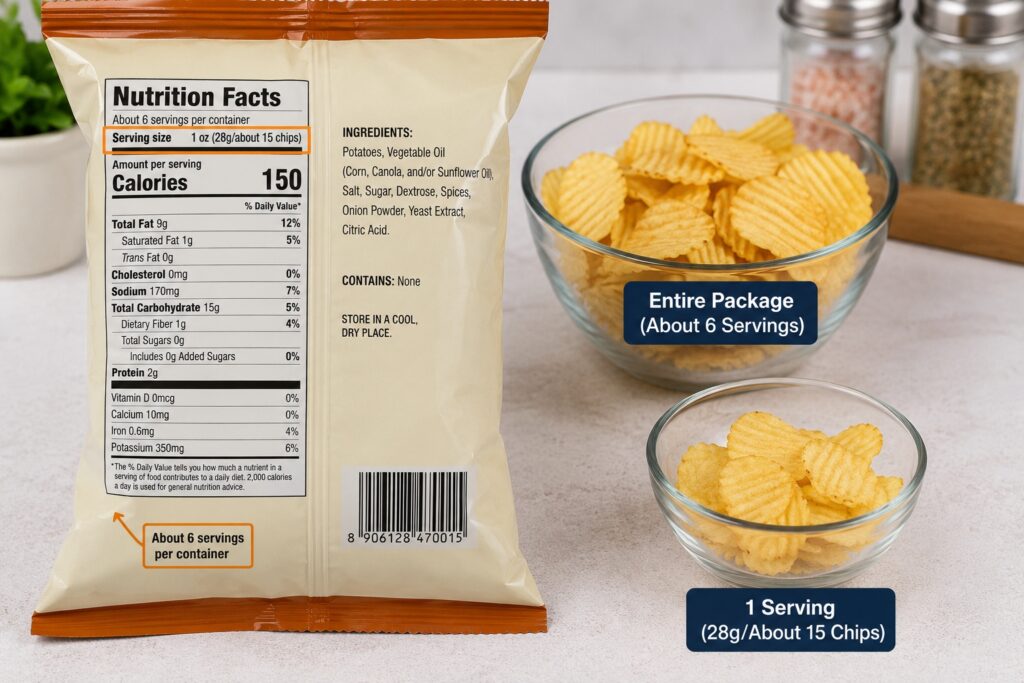
Serving size is the first thing to check on a nutrition label. Every nutrition value that follows — including calories, fat, sugar, protein, and sodium — is based on the stated serving size.
For example, suppose a bag of chips contains 150g of food but lists 30g as one serving. The package contains five servings. If you eat the entire bag, you have consumed five times the calories, fat, sodium, and other nutrients listed for one serving.
Before looking at the individual nutrients, check these two numbers:
- Serving size: How much food does the label consider one serving?
- Servings per package: How many servings are in the entire container?
Then compare the serving size with the amount you would realistically eat. If you normally eat 60g but the label’s serving size is 30g, you’ll need to multiply the listed nutrition values by two to understand what you’re actually consuming.
This is especially important when comparing packaged foods. Two similar products may list different serving sizes, making one appear lower in calories, sugar, or sodium when the difference is simply the amount used for the calculation.
Understanding % Daily Value
The % Daily Value (%DV) tells you how much a nutrient in one serving contributes to a general daily reference amount. It gives you a quick way to judge whether a food contains relatively little or a lot of a particular nutrient without having to interpret the number of grams or milligrams on its own.
As a general guide:
- 5% DV or less is considered low.
- 20% DV or more is considered high.
For example, if a serving provides 25% DV of sodium, that’s a relatively high amount for a single serving. If it provides 4% DV of a nutrient, that’s relatively low.
%DV can be particularly useful when comparing similar products. If two granola bars have similar serving sizes but one provides 22% DV of sodium and the other provides 8%, the second product contributes less sodium per serving.
Keep in mind that %DV is based on general reference values, not your individual nutritional needs. Your calorie and nutrient requirements can vary depending on factors such as age, activity level, and other individual circumstances. Use %DV as a quick comparison tool rather than as a personalized dietary target.
Sugar and Sodium: What to Actually Look At
After checking the serving size and % Daily Value, pay particular attention to sugar and sodium. These numbers can add up quickly when you consume several servings or multiple packaged foods throughout the day.
Check Total Sugar and Added Sugar
If the label provides both, look at total sugars and added sugars separately.
Total sugars include naturally occurring sugars as well as sugars added during processing. For example, milk and fruit naturally contain sugar.
Added sugars are sugars added to foods or beverages during processing or preparation. If a label provides an added-sugar value, use it alongside total sugars to understand where the sugar in the product is coming from.
If added sugars aren’t listed separately, check the ingredient list for ingredients such as sugar, syrup, glucose, fructose, dextrose, maltose, or other sweetening ingredients.
Check Sodium
Sodium is usually listed in milligrams (mg). Don’t confuse sodium with the total amount of salt in a product: they are related, but they are not the same measurement.
A product with a relatively small amount of sodium per serving can still contribute a substantial amount if you eat several servings. That’s why it’s important to check the serving size before judging the sodium number.
Don’t Treat Fat as One Number
The fat section usually includes total fat and may also list saturated fat and trans fat separately.
Rather than looking only at total fat, check the individual categories. A food can contain fat without all of that fat being the same type, so the breakdown provides more useful information than the total number alone.
Reading the Ingredient List
The nutrition facts tell you how much of a nutrient a food contains. The ingredient list helps you understand what the food is actually made from.
Ingredients are generally listed in descending order by weight, meaning the ingredient present in the greatest amount appears first, followed by the next greatest amount, and so on.
This makes the beginning of the ingredient list particularly useful. If sugar, syrup, refined flour, or another ingredient you’re trying to limit appears near the top, it makes up a relatively large share of the product compared with ingredients listed further down.
Look Beyond the Marketing on the Front
Words such as “natural,” “multigrain,” “low fat,” or “no added preservatives” can describe particular characteristics of a product, but they don’t replace the nutrition facts or ingredient list.
For example, a product marketed as multigrain may still contain refined flour as one of its main ingredients. The ingredient list can help you see what is actually present rather than relying only on the claims on the front of the package.
Recognize Added Sugars
Sugar can appear under different names on ingredient lists. Examples include sucrose, glucose, fructose, dextrose, maltose, and various syrups.
You don’t need to memorize every possible name. If a product’s nutrition panel lists a significant amount of sugar, checking the first several ingredients can help you understand whether sweeteners are an important part of the recipe.
The ingredient list is most useful when you read it together with the nutrition panel: the nutrition facts tell you the quantities, while the ingredients tell you what those quantities come from.
How Indian (FSSAI) Labels Work
If you’re buying packaged food in India, you’ll generally see nutrition information presented under rules set by the Food Safety and Standards Authority of India (FSSAI). The format isn’t identical to the nutrition labels used in the US or other countries, so some familiar terms and layouts may look different.
Look for Per 100g or Per 100ml Values
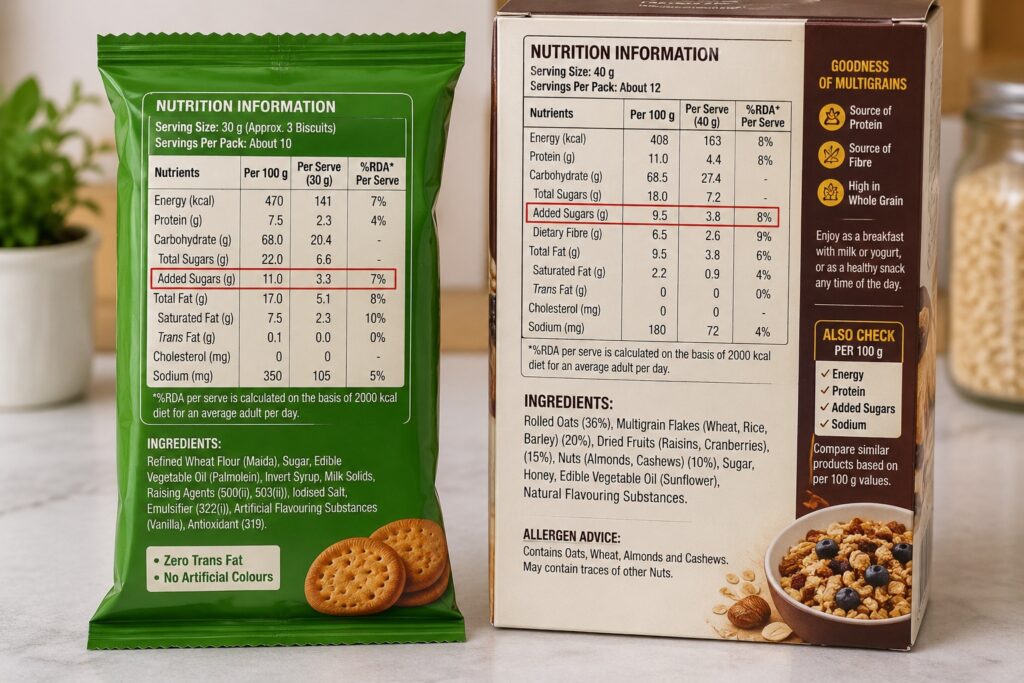
Indian food labels can provide nutrition information per 100g, per 100ml, per serving, or other specified formats, depending on the product and applicable requirements. This makes the per 100g or per 100ml figure particularly useful when comparing similar products.
For example, if one biscuit brand lists 480 kcal per 100g and another lists 530 kcal per 100g, you can compare those figures directly even if the brands use different serving sizes.
Check Total Sugars and Added Sugars
FSSAI nutrition-labelling requirements include declarations for total sugars and added sugars in the nutrition information for applicable packaged foods.
This means you don’t always have to rely on the ingredient list to determine whether a product contains added sugar. When an added-sugar value is provided, use it alongside total sugars to understand the product’s sugar content.
The ingredient list is still useful because it shows which ingredients are used and their relative order by weight.
Pay Attention to Sodium and Other Nutrients
Indian nutrition labels can also provide information such as energy, protein, carbohydrate, total fat, saturated fat, trans fat, sugars, and sodium, depending on the applicable labelling requirements.
You may also see a per-serving percentage contribution to Recommended Dietary Allowance (RDA). FSSAI’s current framework uses reference values based on a 2,000 kcal daily energy requirement for an average adult.
Don’t Assume Indian and US Labels Use the Same Rules
A useful rule is to read the label according to the information actually provided on the package rather than assuming that an Indian product follows the exact same format as a US nutrition label.
For everyday shopping, three checks are especially useful:
- Serving size: How much does one serving represent?
- Per 100g/100ml values: How does the product compare with similar products?
- Ingredients and nutrition values: What is the product made from, and how much sugar, sodium, fat, protein, and energy does it provide?
Label Element Quick Reference
| Label element | What it tells you | Quick check |
|---|---|---|
| Serving size | The amount of food or drink used to calculate the nutrition values | Compare it with the amount you would actually consume |
| Servings per package | How many servings the entire package contains | Multiply the per-serving values by the number of servings you eat |
| Calories / Energy | The amount of energy provided by a serving | Check alongside serving size rather than looking at calories alone |
| % Daily Value / RDA contribution | How much one serving contributes to a general daily reference amount | Use it as a quick comparison tool |
| Total sugars | The total amount of sugars in the food | Check the serving size and compare with similar products |
| Added sugars | Sugars added during processing or preparation, where separately declared | Compare with total sugars to understand the product’s sugar content |
| Sodium | The amount of sodium in the food, usually shown in mg | Check how much you consume across multiple servings and foods |
| Total fat | The total amount of fat in a serving | Look at saturated and trans fat separately where listed |
| Ingredient list | Ingredients listed generally from highest to lowest by weight | Check the first several ingredients to understand what makes up the product |
| Per 100g / 100ml | Nutrient values standardized to the same quantity | Use this to compare similar products more easily |
How to Read a Nutrition Label in 30 Seconds
You don’t need to study every number on a package to make a quick comparison. Use this simple five-step check:
- Check the serving size.
See how much food or drink the label considers one serving and how many servings are in the package. - Look at calories or energy.
Make sure you’re looking at the amount for the serving size you actually plan to eat. - Check sugar and sodium.
Look at total sugars and added sugars when separately listed, then check the sodium amount. - Scan the ingredient list.
Look at the first several ingredients to understand what makes up most of the product by weight. Watch for ingredients you specifically want to limit or avoid. - Compare similar products using the same quantity.
When shopping in India, the per 100g or per 100ml values can make comparisons easier when different brands use different serving sizes.
A simple rule to remember
Serving size → Calories → Sugar → Sodium → Ingredients → Compare
You don’t have to memorize every number on a nutrition label. The goal is to understand what you’re eating and make a more informed comparison between products.
FAQ
What’s the first thing I should check on a nutrition label?
Start with the serving size and number of servings per package. Every nutrition value on the label is based on the stated serving size, so this tells you how the calories, sugar, sodium, fat, and other nutrients relate to the amount you’re actually eating.
What does % Daily Value mean on a nutrition label?
% Daily Value (%DV) shows how much one serving contributes to a general daily reference amount for a nutrient. As a general guide, 5% DV or less is considered low, while 20% DV or more is considered high. Use %DV as a quick comparison tool rather than as a personalized dietary target.
Is per 100g better than per serving?
Neither is always better; they serve different purposes. Per serving helps you understand what you’re consuming in one portion, while per 100g or 100ml makes it easier to compare similar products when serving sizes differ.
How can I tell if a packaged food is high in sugar?
Check the serving size, total sugars, and added sugars when separately listed. Then look at the ingredient list to see whether sugar or other sweetening ingredients appear near the beginning of the list. Comparing the per 100g value can also help when choosing between similar products.
What’s the difference between total sugar and added sugar?
Total sugars include both naturally occurring and added sugars. Added sugars are sugars introduced during processing or preparation. If both values appear on the label, comparing them can help you understand how much of the product’s sugar comes from added sources.
Is sodium the same as salt?
No. Sodium and salt are related but are not the same measurement. Nutrition labels generally report sodium, usually in milligrams (mg). Because sodium can come from several ingredients and foods, check the sodium value rather than assuming it represents the total amount of salt.
How do I compare two nutrition labels?
Compare the products using the same quantity, preferably per 100g or 100ml when those values are provided. Then compare serving size, calories or energy, sugar, sodium, fat, protein, and the ingredient lists. This avoids being misled by different serving sizes.
How do Indian nutrition labels differ from US nutrition labels?
Indian packaged-food labels follow FSSAI requirements and can use different formats and reference values from US labels. When reading an Indian label, pay attention to the serving information, per 100g or 100ml values, nutrient declarations, %RDA information where provided, and the ingredient list.
Disclaimer: This article is intended for general educational and informational purposes only. Nutrition labels can vary by product, country, and applicable regulations. The information here should not be considered medical or dietary advice. If you have a medical condition, food allergy, or specific dietary requirement, consult a qualified healthcare professional or registered dietitian for personalized guidance.

Rohini writes about home styling, beauty, fashion, food, and travel from Bangalore, India — drawing on her background in interior styling and years of testing what actually works in real homes and everyday routines. Every recommendation here comes from something she’s personally tried, not aggregated advice.