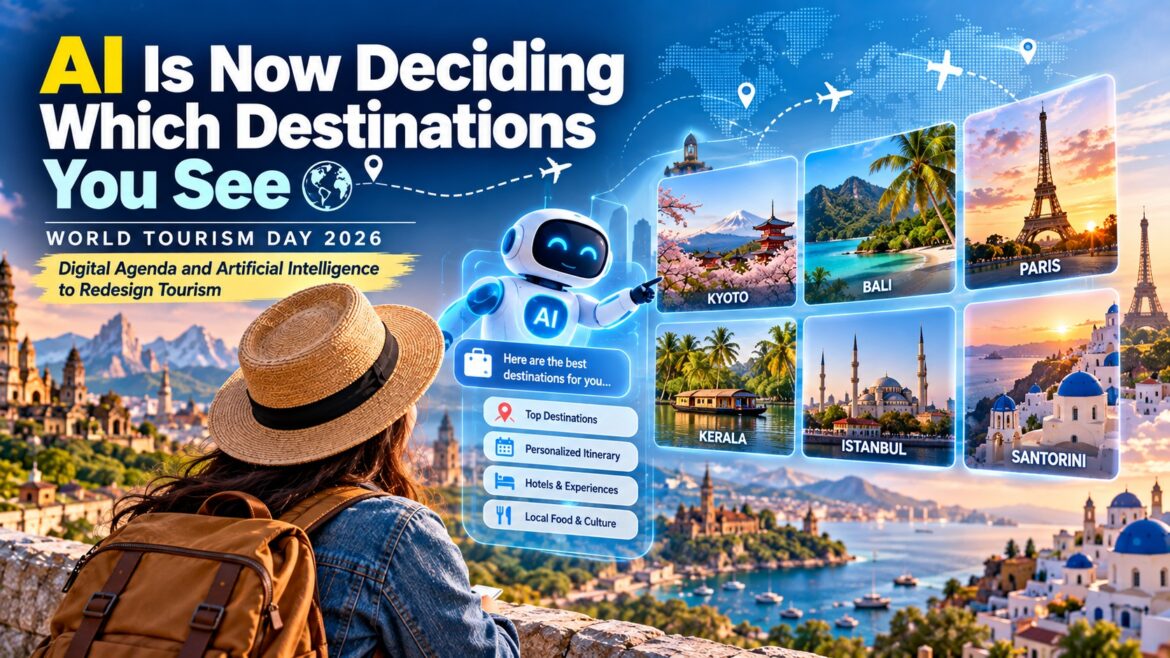
World Tourism Day 2026 arrives at a moment when artificial intelligence is beginning to change one of the most important parts of travel: how people decide where to go.
The official 2026 theme, “Digital Agenda and Artificial Intelligence to Redesign Tourism,” puts AI at the center of the global tourism conversation.
For travelers, that can mean asking an AI assistant for a three-day itinerary instead of opening dozens of search results. For tourism boards, hotels and travel publishers, it creates a new challenge: how do you make sure your destination is included in those AI-generated recommendations?
The traditional competition for Google’s first page is no longer the entire visibility game.
A second layer is emerging — one where AI systems can summarize destinations, recommend hotels, compare experiences and construct entire itineraries from information available across the web.
And that could have significant consequences for lesser-known destinations.
From 10 Blue Links to One AI Answer
For years, tourism businesses focused heavily on traditional search engine optimization.
They optimized destination pages, built backlinks, targeted travel keywords and tried to appear among the top results for searches such as:
- Best places to visit in India
- Best hotels in Kerala
- Things to do in Coorg
- Places to visit in Rajasthan
That model is still important.
But travelers increasingly have another option.
Instead of searching for individual pieces of information, they can ask an AI assistant:
“Plan a three-day trip to Coorg for a family, including hotels, local food, sightseeing and places that aren’t overcrowded.”
The resulting answer may contain a handful of destinations, attractions, hotels or restaurants.
That changes the definition of visibility.
A tourism business may not simply need to rank on a search results page. Its information needs to be available in a form that AI systems can understand, evaluate and potentially use when generating an answer.
This is where Answer Engine Optimization (AEO) and Generative Engine Optimization (GEO) are becoming increasingly relevant.
Why AI Recommendations Matter for Tourism
Travel decisions are particularly suited to AI-assisted discovery because planning a trip involves connecting many different pieces of information.
A traveler may need to know:
- Where should I go?
- When should I visit?
- How do I get there?
- Where should I stay?
- What should I see?
- How much will it cost?
- What local food should I try?
- How long should I stay?
- What should I avoid?
- Are there less crowded alternatives?
Traditionally, answering those questions meant visiting multiple websites.
An AI assistant can potentially combine them into a single conversation.
That convenience could make AI an increasingly important discovery layer for tourism.
The Visibility Problem for Lesser-Known Destinations
This is where the issue becomes particularly important for countries such as India.
India has thousands of destinations, heritage sites, local experiences, homestays and regional tourism circuits that receive far less online coverage than globally recognized destinations.
Consider the difference between asking an AI:
“What are the best places to visit in India?”
and asking:
“What are some lesser-known heritage destinations in Madhya Pradesh with good road connectivity and local cultural experiences?”
The quality of the answer depends partly on the information available to the AI system.
If a destination has detailed, trustworthy and accessible information online, it has more material that can potentially support an AI-generated recommendation.
If information is scattered across poorly maintained websites, social media posts or pages with little useful detail, the destination may be harder for an AI system to confidently describe.
That doesn’t necessarily mean the destination is less attractive.
It can simply mean its digital footprint is weaker.
India’s Tourism Opportunity
The issue matters economically.
According to India’s Ministry of Tourism, tourism contributed 5.22% to India’s GDP in 2023–24 and supported approximately 84.6 million jobs.
That means changes in how travelers discover destinations could eventually affect businesses far beyond major hotels and airlines.
Think about the wider ecosystem:
- Local homestays
- Tour guides
- Restaurants
- Handicraft businesses
- Transport operators
- Adventure tourism companies
- Heritage attractions
- Regional food businesses
- Small hotels
- Tourism experiences
If AI becomes an increasingly common starting point for travel planning, being absent from those recommendations could become a genuine digital visibility problem.
The UN’s Warning About AI and Tourism
The global discussion around AI in tourism is not simply about making trip planning faster.
There is also a question of who benefits from AI-driven tourism discovery.
UN Tourism has highlighted the need for digital transformation and AI to support inclusive and sustainable tourism rather than increasing existing inequalities between destinations.
There is a potential risk here.
If AI systems repeatedly recommend destinations that already have enormous amounts of online information, those destinations could receive even more attention.
Meanwhile, smaller destinations with limited digital resources could struggle to enter the recommendation ecosystem.
In other words, AI could potentially help distribute tourism more widely — but it could also reinforce existing patterns of visibility.
The outcome will depend partly on the data, content and systems used to build these recommendations.
What Tourism Brands Can Do Now
This is not only a technology problem.
It is also a content strategy problem.
Tourism boards, hotels, destination marketers and travel publishers can begin preparing for AI-driven discovery today.
1. Answer Real Traveler Questions
Don’t create content simply because a keyword has search volume.
Build content around questions travelers actually ask.
Instead of:
“Coorg Tourism”
create useful sections such as:
- What is the best time to visit Coorg?
- How many days are enough for Coorg?
- How do you reach Coorg from Bengaluru?
- What are the best coffee experiences in Coorg?
- What are the lesser-known places to visit near Coorg?
This makes the content useful for traditional search as well as AI-powered answers.
2. Give AI Something Specific to Cite
Generic tourism copy is easy to reproduce.
Specific information is more useful.
Include details such as:
- Distances
- Travel times
- Opening hours
- Seasonal information
- Transportation options
- Ticket prices where appropriate
- Accessibility information
- Local experiences
- Contact information
- Official sources
Of course, information that changes frequently should be reviewed and updated regularly.
3. Publish Original Information
One of the biggest opportunities for tourism organizations is first-party information.
A tourism board could publish:
- Visitor statistics
- Seasonal tourism data
- Local event calendars
- Destination guides
- Transport information
- New attractions
- Visitor trends
- Official recommendations
A hotel or homestay could publish genuinely useful local knowledge rather than another generic “Top 10 Places to Visit” article.
Original information can help establish a stronger digital footprint.
4. Make Content Machine-Readable
Good content needs to work for both humans and machines.
Clear headings, descriptive page titles, structured information, tables, FAQs, internal links and appropriate structured data can make information easier for search engines and AI systems to understand.
This doesn’t mean writing for machines instead of people.
It means making useful information easy for both to interpret.
5. Build Topical Authority
A single destination page isn’t enough.
A tourism brand covering Coorg, for example, could build a useful information ecosystem covering:
Destination → Getting There → Accommodation → Attractions → Food → Activities → Seasons → Events → Local Experiences → FAQs
This creates depth around the destination and provides multiple entry points for travelers and AI systems.
6. Keep Information Fresh
Travel information changes constantly.
A page that accurately describes a destination today may contain outdated information a year later.
Tourism websites should regularly review:
- Opening hours
- Prices
- Transport routes
- Hotel information
- Events
- Attractions
- Travel restrictions
- Contact details
- Seasonal information
Freshness matters because travelers need current information, not simply well-written information.
SEO Is Not Dead. The Discovery Layer Is Expanding.
The rise of AI doesn’t mean traditional SEO suddenly becomes irrelevant.
Search engines remain an important way for travelers to discover information.
Instead, the ecosystem is becoming more complex:
Search → Search Results → Websites → AI Answers → AI Recommendations → Potentially AI-Assisted Actions
A tourism organization therefore needs to think beyond ranking for keywords.
The bigger question is:
Can travelers — and the systems helping travelers — find, understand and trust our information?
That is a much broader digital visibility challenge.
The Next Stage: AI Travel Agents
The biggest change may come when AI moves from simply answering travel questions to actually helping coordinate travel.
Imagine saying:
“Plan a five-day Kerala trip for my family. Keep the budget below ₹75,000, avoid changing hotels every day, include local food experiences and prioritize less crowded destinations.”
An AI system could potentially research destinations, compare options, build an itinerary and eventually connect the traveler with booking and travel services.
That moves tourism toward an agentic AI model.
The AI isn’t simply telling you where to go.
It is helping accomplish the larger goal:
“Plan my trip.”
This could fundamentally change the relationship between travelers, search engines, travel platforms and tourism businesses.
But Should AI Decide Where We Travel?
There is an important human question behind all of this.
Travel isn’t only about optimization.
The best travel memories don’t always come from the destination with the highest rating or the itinerary with the shortest travel time.
Sometimes they come from an unexpected restaurant, a conversation with a local, a road taken by mistake or a small place that wasn’t on the original itinerary.
AI can make travel planning easier.
But it shouldn’t necessarily eliminate curiosity and discovery.
The challenge for the tourism industry will be finding the right balance between personalization and exploration.
World Tourism Day 2026 Is About More Than AI
The significance of this year’s theme goes beyond another new technology trend.
Tourism is entering a period where digital visibility can increasingly influence physical travel.
If an AI system recommends a destination, that recommendation can potentially influence where someone spends money, which hotel they book, which restaurant they visit and which attractions receive visitors.
That gives tourism organizations a new responsibility.
They need to ensure that their destinations are represented online with information that is accurate, trustworthy, useful, current and accessible.
For smaller destinations, this could be an opportunity.
For established destinations, it is another competitive layer.
And for travelers, it could mean that the way they discover the world is about to become very different.
The AI Tourism Race Has Already Started
World Tourism Day is traditionally an opportunity to celebrate travel, culture and the economic importance of tourism.
In 2026, there is another conversation worth having.
Who gets discovered when AI becomes the travel assistant?
The answer will depend partly on the quality of information available online, the systems that process it and the choices made by tourism organizations today.
The opportunity is still open.
Tourism destinations that invest in useful digital information, original content and trustworthy online experiences can give themselves a better chance of being discovered in this new environment.
The future of tourism may not begin with:
“Google it.”
Increasingly, it may begin with:
“Ask AI.”
Frequently Asked Questions
What is the theme of World Tourism Day 2026?
The theme of World Tourism Day 2026 is “Digital Agenda and Artificial Intelligence to Redesign Tourism.”
How is AI changing tourism?
AI is changing tourism through personalized trip planning, destination recommendations, translation, customer service, content discovery, data analysis and increasingly automated travel workflows.
What is GEO in tourism?
Generative Engine Optimization (GEO) is the practice of creating and structuring content so that it can be understood, referenced and potentially surfaced by generative AI systems when users ask travel-related questions.
Is traditional SEO still important for tourism websites?
Yes. Traditional search remains an important source of travel discovery. However, tourism organizations increasingly need to consider both traditional search visibility and visibility within AI-generated answers.
Can AI help lesser-known tourist destinations?
Potentially. AI could introduce travelers to destinations they might not otherwise discover. However, destinations need sufficient accurate, trustworthy and accessible online information for AI systems to understand and recommend them confidently.
What should tourism businesses do to prepare for AI search?
They can focus on answering real traveler questions, publishing original information, maintaining accurate destination data, using clear website structures and building authority around their destination or area of expertise.
Final Thought
The future of tourism may not be about who ranks first. It may increasingly be about who gets mentioned first.

Rohini writes about home styling, beauty, fashion, food, and travel from Bangalore, India — drawing on her background in interior styling and years of testing what actually works in real homes and everyday routines. Every recommendation here comes from something she’s personally tried, not aggregated advice.