Christmas has a way of costing more than anyone planned. A gift here, a “while I’m at it” add-on there, a few last-minute orders with express shipping, and by January the card statement tells a very different story from the one in your head.
The fix isn’t spending less on the people you love. It’s deciding what you’ll spend before you start, and keeping track as you go. Here’s a simple way to do that in five steps, plus a four-week countdown so nothing piles up on 24 December.
Quick answer
To plan a Christmas gift budget, set one total amount you can comfortably pay from savings or this month’s income, split it by person and by category (gifts, food, decorations, cards, wrapping), write a gift list before you shop, and log every purchase as you make it. Check your total once a week until Christmas.
Step 1: Set one total Christmas budget first
Start with a single number for the whole season, not a number per gift. A total keeps every other decision honest.
To find it, look at what you can pay without borrowing:
- Money you’ve already saved for Christmas
- What’s left of this month’s and next month’s income after bills and savings
- Any gift money you already know is coming, such as a work bonus
Then subtract a small buffer for the things you always forget, like batteries, extra wrapping paper or a gift for a neighbour.
A worked example: say you can set aside 600 across November and December. Keep 50 as a buffer, and your working Christmas budget is 550. (Use your own currency. The numbers work the same way in dollars, pounds, euros or rupees.)
Christmas Gift & Budget Planner (Printable PDF + Spreadsheet) https://worthview.gumroad.com/l/christmas-gift-budget-planner
Step 2: Split it by category and by person
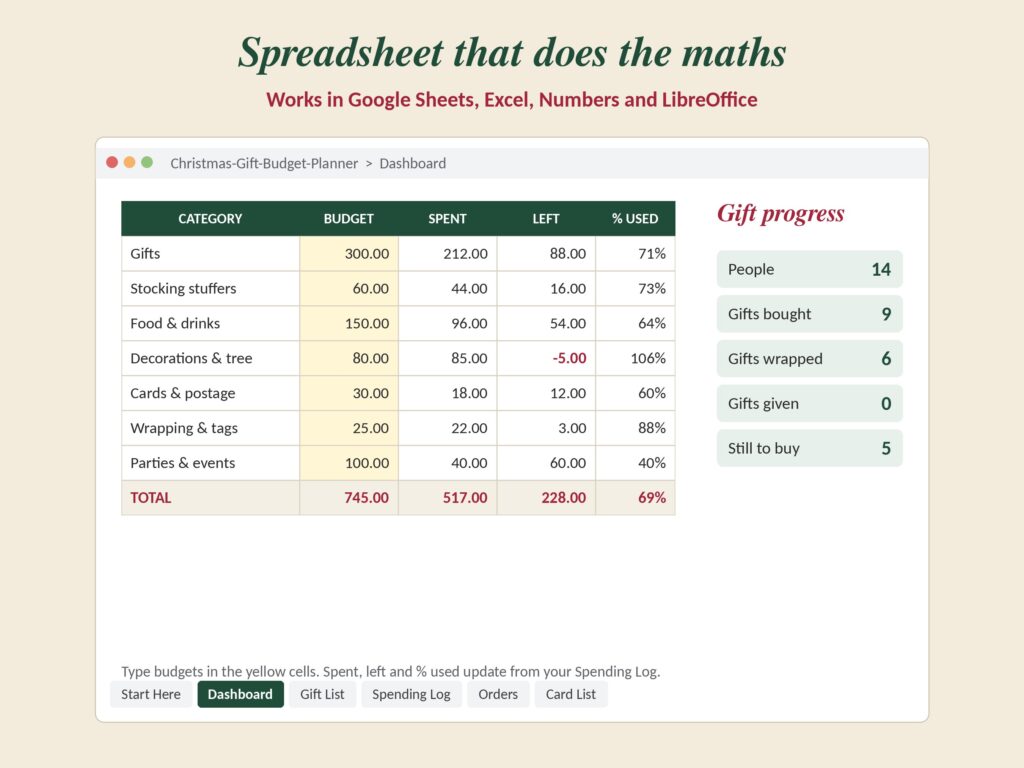
Get the Christmas Gift & Budget Planner (Printable PDF + Spreadsheet) https://worthview.gumroad.com/l/christmas-gift-budget-planner
Christmas is more than gifts, so give each part of the season its own slice.
| Category | Example budget |
|---|---|
| Gifts | 300 |
| Food and drinks | 100 |
| Decorations and tree | 50 |
| Stocking stuffers | 40 |
| Cards and postage | 20 |
| Wrapping and tags | 20 |
| Parties and outings | 20 |
| Total | 550 |
Now split the gift slice by person. It helps to sort people into groups first:
- Close family: your partner, children, parents
- Extended family and close friends
- Small thank-yous: teachers, colleagues, neighbours, the person who delivers your parcels
Give each group a per-person amount, then check the total still fits. If it doesn’t, adjust the groups, not the total.
How much should you spend per person?
There’s no right number. It depends on your budget, not on what others spend. A thoughtful small gift lands better than an expensive one that strains your month. If a group of friends or family usually swaps gifts, suggesting a spending limit or a Secret Santa draw is completely normal, and most people are relieved when someone does.
Step 3: Make your gift list before you shop
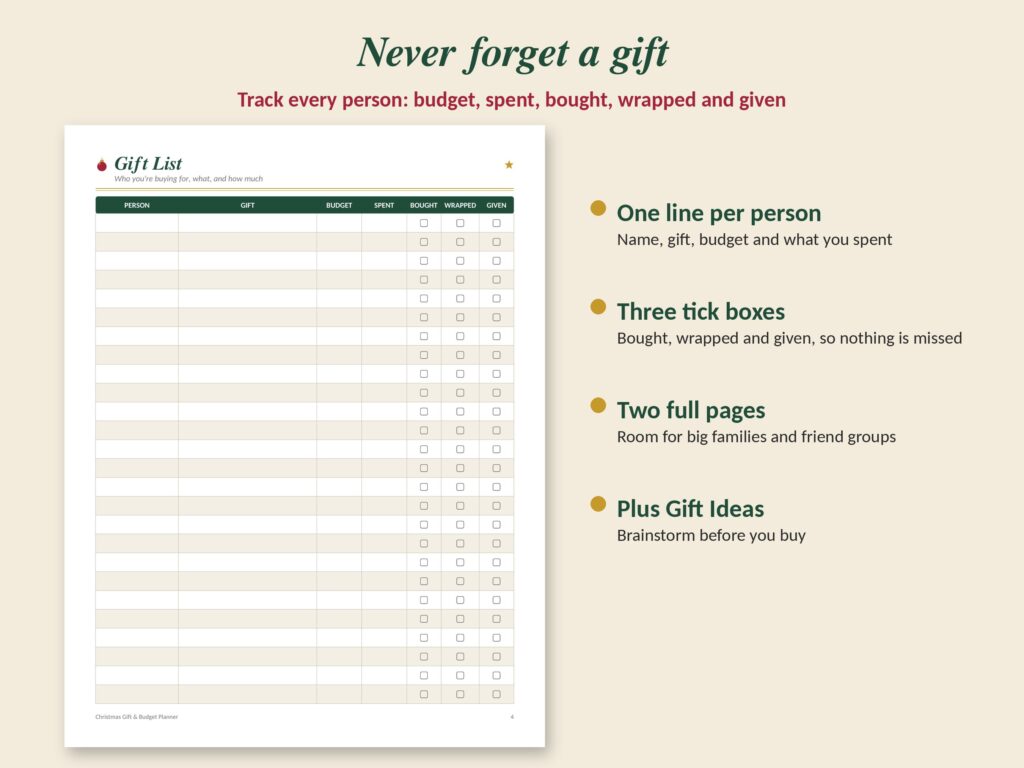
Shopping without a list is where budgets quietly break. Before you open a single shopping app, write down:
- Each person’s name
- One or two gift ideas
- The budget for that person
Keep a running “ideas” list for the people who are hard to buy for. When you notice something they’d love during the year, it goes on the list, and next December starts half done.
Full Christmas Gift & Budget Planner (Printable PDF + Spreadsheet) https://worthview.gumroad.com/l/christmas-gift-budget-planner
Step 4: Track every purchase as you make it
This is the step most people skip, and it’s the one that keeps you on budget. Every time you buy something, note:
- What it was and who it’s for
- What you actually paid, including delivery
- The order number and the expected delivery date
- The return deadline, in case it’s the wrong size or colour
Two habits make this painless. First, log the purchase straight away, not “later”. Second, compare spent against budget for each person as you go, so you know there’s room left for a stocking filler before you buy it, not after.
Tracking orders and delivery dates also saves you from the most stressful Christmas moment of all: realising on 22 December that a parcel never arrived.
Step 5: Plan wrapping, cards and thank-yous early
The small jobs take more time than you expect, and they all land in the same week if you let them. Give each one a place in your plan:
- Wrapping: tick off each gift as it’s wrapped, and note which ones need to be posted or handed over early.
- Cards: keep one list of names and addresses, and mark who you’ve sent to and who you’ve heard from.
- Thank-you notes: after Christmas, note who gave what, so the thank-yous are easy to write in the first week of January.
A 4-week December countdown
Week 1 (start of December)
- Set your total budget and split it by category and person
- Write your gift list and ideas
- Order anything that needs to be shipped from far away
Week 2
- Buy most of the gifts on your list
- Log every order with its delivery date
- Write and post cards, especially international ones
Week 3
- Chase any late orders and buy replacements if needed
- Wrap as gifts arrive
- Plan your Christmas food shop
Week 4 (Christmas week)
- Buy fresh food and last stocking stuffers
- Finish wrapping and labelling
- Check your final total against your budget, then stop shopping and enjoy it
Want it all in one place?
If you’d rather not build all of this yourself, I put the whole system into a Christmas Gift & Budget Planner. It’s a 15-page printable PDF (A4 and US Letter) with a gift list, budget overview, shopping list, orders and deliveries tracker, card list, wrapping checklist, December countdown and thank-you tracker, plus a spreadsheet for Google Sheets or Excel that adds up your budget, spent and remaining amounts for you and turns red when a category goes over.
It’s undated and has no currency symbols, so it works wherever you live and you can use it again next year.
Frequently asked questions
How do I make a Christmas budget?
Decide one total you can pay without borrowing, split it into categories such as gifts, food, decorations, cards and wrapping, then split the gift amount by person. Track every purchase against those numbers until Christmas.
How much should I spend on Christmas gifts per person?
It depends on your total budget, not on what other people spend. Group people into close family, extended family and friends, and small thank-yous, give each group a per-person amount, and check that the total still fits.
How do I stop overspending at Christmas?
Shop from a written gift list, log each purchase straight away, and compare what you’ve spent with your budget for each person before you buy anything extra. A small buffer for forgotten items also keeps surprises from breaking the plan.
Is a spreadsheet or a printable planner better for a Christmas budget?
Use whichever you’ll actually open. A spreadsheet does the maths for you and is easy to update on your phone. A printable is easier to keep on the fridge and tick off by hand. Many people use both: the spreadsheet for money and the printable for lists.
When should I start planning for Christmas?
The earlier the better, but even starting in December works if you follow a week-by-week countdown. Starting in October or November gives you time to spread the cost over two or three pay cycles.

Rohini writes about home styling, beauty, fashion, food, and travel from Bangalore, India — drawing on her background in interior styling and years of testing what actually works in real homes and everyday routines. Every recommendation here comes from something she’s personally tried, not aggregated advice.