
Mahatma Gandhi was a man of action and simple living, but he was also a deep thinker. He believed that to change the world, you must first change yourself. The principles he developed were not just for politics; they were a roadmap for living a good life, for everyone. These 11 vows, or ekadash vrat, were meant for people in his ashrams, but their message is universal.
Here is what his 11 principles mean in simple language:
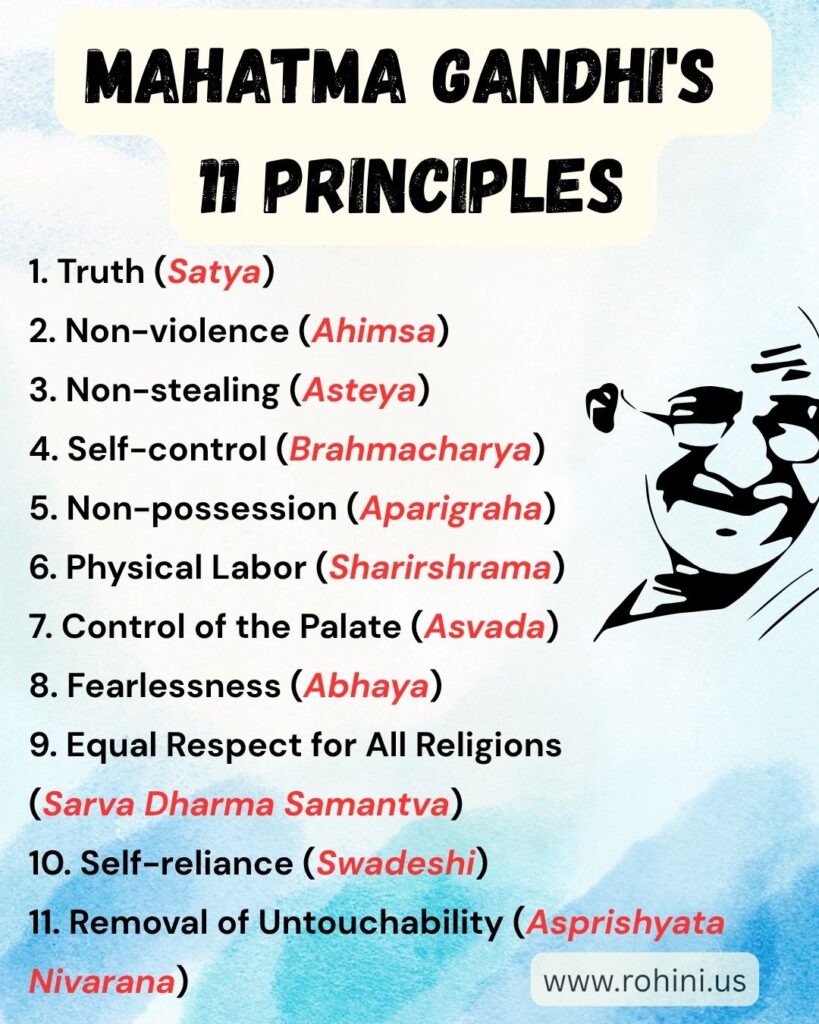
Contents
hide
1. Truth (Satya)
This was the most important rule for Gandhi. He believed that truth is God. It’s about being truthful in your thoughts, words, and actions, not just avoiding lies.
For Gandhi, truth was not just about avoiding lies; it was a way of living. He believed truth must guide every thought, word, and action. To him, truth was inseparable from morality and justice—it was the foundation of all virtues.
He often said, “Truth is God,” meaning that by living truthfully, one comes closer to the divine. Gandhi’s pursuit of truth was not rigid but experimental. He called his life a series of “experiments with truth,” showing that truth must be tested, practiced, and refined every day.
2. Non-violence (Ahimsa)
This goes beyond not hurting others physically. It’s about having love and compassion for all living things. It means getting rid of jealousy, hatred, and the desire to harm anyone.
Ahimsa was the soul of Gandhi’s philosophy. He saw non-violence as active love rather than mere absence of harm. True non-violence meant eliminating hatred and jealousy and replacing them with understanding and compassion.
He also believed non-violence was a powerful weapon of resistance. Through peaceful protest and civil disobedience, Gandhi proved that one could fight injustice without resorting to bloodshed, making Ahimsa a universal principle.
3. Non-stealing (Asteya)
This is more than just not taking things that don’t belong to you. Gandhi taught that if you hold onto something you don’t need, you’re stealing from someone who does. It’s a call for simplicity and not being greedy.
Gandhi extended the idea of stealing beyond the obvious act of theft. He taught that keeping more than you need is also a form of stealing, because it deprives others of their fair share. This view challenges us to reflect on consumerism and excess in daily life.
He believed Asteya demanded simplicity and fairness. To live by this principle is to be mindful of one’s resources and ensure that they are used responsibly, for the good of both oneself and society.
4. Self-control (Brahmacharya)
For Gandhi, Brahmacharya was not limited to celibacy. It was about complete mastery over one’s desires and senses. He believed that uncontrolled passions weakened both body and mind.
By practicing discipline, Gandhi argued, a person could channel their energy into higher purposes—like service, learning, or spiritual growth. Self-control was, therefore, a path to inner strength and freedom.
5. Non-possession (Aparigraha)
Aparigraha was Gandhi’s call to live with simplicity. He believed hoarding material things creates greed, fear, and inequality in society. True freedom comes not from what we own, but from what we can do without.
He himself lived by example, owning only the bare minimum. By giving up attachment to possessions, one develops trust in life and learns to focus on values that truly matter—compassion, truth, and service.
6. Physical Labor (Sharirshrama)
Gandhi believed that everyone, regardless of their work, should do some kind of manual labor to earn their food. He wanted people to value hard work and reduce the gap between different social classes.
Gandhi emphasized the dignity of labor. He believed every person, no matter their education or status, should engage in manual work. This would not only keep the body fit but also remove social divisions between “mental” and “physical” workers.
He personally spun the charkha (spinning wheel) daily and urged others to do the same, symbolizing self-reliance and equality. Sharirshrama taught that no work is menial and that true respect lies in honest effort.
7. Control of the Palate (Asvada)
This vow emphasizes eating to live, not living to eat. It’s about controlling your taste buds and eating simple, healthy food for your body’s needs. Gandhi believed that mastering this sense helps control all others.
By practicing moderation in food, one could cultivate discipline over other senses as well. Gandhi lived on a simple vegetarian diet and often fasted, showing that mastery over appetite leads to clarity of mind and strength of spirit.
8. Fearlessness (Abhaya)
Gandhi, who was a timid child, worked hard to become fearless. He believed you must conquer your fears—of death, injury, disapproval, and poverty—to be able to pursue the truth without holding back.
He believed fear is the root of many evils—cowardice, dishonesty, and oppression. To be fearless is not to be reckless but to act with confidence in truth and justice, no matter the consequences. This fearlessness became the backbone of his freedom struggle.
9. Equal Respect for All Religions (Sarva Dharma Samantva)
This principle was especially important in a diverse country like India. It teaches that all religions are different paths to the same truth. It requires respecting other people’s faiths just as you do your own.
He often read from the Gita, Bible, and Quran to show that wisdom lies in all traditions. Sarva Dharma Samantva calls for tolerance, dialogue, and harmony—values urgently needed in today’s divided world.
10. Self-reliance (Swadeshi)
Swadeshi means focusing on your own community first. It was a practical way to fight for independence by supporting local businesses and products instead of foreign ones. It’s about building a strong, self-sufficient community.
But beyond politics, Swadeshi meant valuing one’s community, culture, and resources. It is about reducing dependence on external systems and building strength within, fostering resilience and collective pride.
11. Removal of Untouchability (Asprishyata Nivarana)
Gandhi fought hard against this unjust and discriminatory practice in India. This principle means that all people are equal, no matter what caste they are born into. He called untouchability a “cancer” on society that needed to be removed.
He gave them the name “Harijan” (children of God) and promoted equal rights, dignity, and opportunity for all. This principle was not only about social justice but also about healing society and upholding the idea that all humans are equal before God.
Conclusion
Gandhi’s principles show that a true revolution begins with yourself. They are not just ideas for a political movement but are guidelines for living a better, more ethical life. Even in today’s modern world, with its focus on fast progress and material goods, Gandhi’s timeless wisdom offers a roadmap to a more peaceful, just, and harmonious world. By practicing these vows, we can all work towards being the change we wish to see.
Frequently asked questions
Q: Are Gandhi’s principles still relevant today?
A: Yes, many people still find Gandhi’s principles relevant in their personal and social lives. Concepts like non-violence, truth, and simplicity are universal and can help address many modern problems, from conflict resolution to environmental sustainability.
A: Yes, many people still find Gandhi’s principles relevant in their personal and social lives. Concepts like non-violence, truth, and simplicity are universal and can help address many modern problems, from conflict resolution to environmental sustainability.
Q: How can an average person apply these principles?
A: You can start with small, everyday actions. For example, be truthful in your conversations, practice self-control by managing your desires, support local businesses (swadeshi), and work to treat all people with equal respect and compassion.
A: You can start with small, everyday actions. For example, be truthful in your conversations, practice self-control by managing your desires, support local businesses (swadeshi), and work to treat all people with equal respect and compassion.
Q: Did Gandhi himself always follow these principles perfectly?
A: Gandhi was a deeply introspective man who never claimed to be perfect. He saw the principles as an ideal to strive for and openly wrote about his own struggles and growth in trying to live by them. His honesty in this regard is part of his legacy.
A: Gandhi was a deeply introspective man who never claimed to be perfect. He saw the principles as an ideal to strive for and openly wrote about his own struggles and growth in trying to live by them. His honesty in this regard is part of his legacy.
Q: How do these principles compare with common modern values?
A: While modern society often values competition, ambition, and consumerism, Gandhi’s principles encourage a shift toward cooperation, self-reflection, and minimalism. They offer an alternative, focusing on inner fulfillment and community well-being over material success.
A: While modern society often values competition, ambition, and consumerism, Gandhi’s principles encourage a shift toward cooperation, self-reflection, and minimalism. They offer an alternative, focusing on inner fulfillment and community well-being over material success.
Q: Did Gandhi get these ideas on his own?
A: Gandhi was influenced by a variety of sources, including ancient Indian religious texts, the writings of thinkers like Tolstoy and Ruskin, and his own experiences with injustice. He synthesized these ideas into a practical philosophy for social change.
A: Gandhi was influenced by a variety of sources, including ancient Indian religious texts, the writings of thinkers like Tolstoy and Ruskin, and his own experiences with injustice. He synthesized these ideas into a practical philosophy for social change.

Rohini writes about home styling, beauty, fashion, food, and travel from Bangalore, India — drawing on her background in interior styling and years of testing what actually works in real homes and everyday routines. Every recommendation here comes from something she’s personally tried, not aggregated advice.