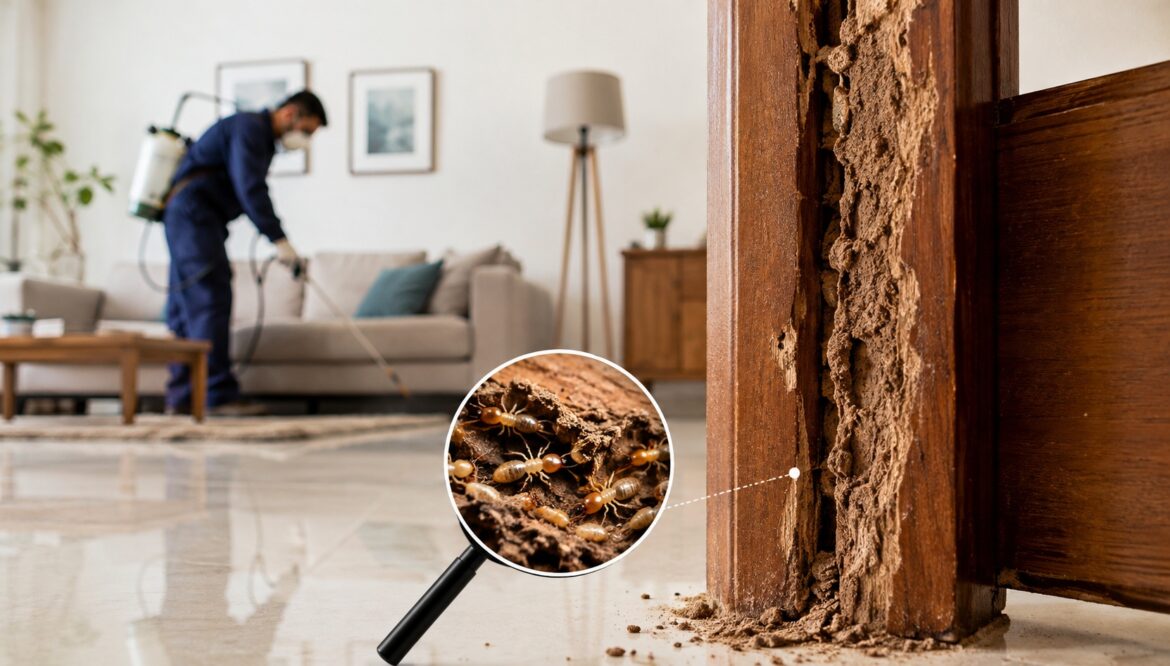
I found out I had termites the way most people do — by accident. I was moving a bookshelf away from the wall in my study to vacuum behind it, and the back panel came away in my hand. Not fell — crumbled. What looked like solid teak-veneer wood was basically a shell, hollowed out from the inside. That was the start of an eight-month back-and-forth that cost me more than it needed to, mostly because I tried to solve it cheaply first.
This is the full version of what happened — what I tried, what didn’t work, what did, and what it actually cost. Not a generic “how to identify termites” list. If you want that, there are plenty. This is the version with the failures included.
How I Found Out I Had Termites
Besides the crumbling wood, the other giveaway I’d missed for weeks was a thin, mud-colored tube running up the inside corner of the wall behind the shelf — almost like a vein of dried mud. That’s a termite mud tube, and by the time you can see one clearly, the colony behind it has usually been active for months. I also found a small scatter of discarded, papery wings near the windowsill from a swarming event I hadn’t even noticed happening.
Signs of Termites in a Bangalore Home
If you’re still trying to figure out whether what you’re looking at is actually termites, these are the signs I’d now check for, room by room:
| Sign | What it looks like |
|---|---|
| Mud tubes | Thin, pencil-width tunnels of dried mud along walls, skirting, or furniture legs |
| Hollow-sounding wood | Tapping produces a dull, papery sound instead of solid knock |
| Discarded wings | Small translucent wings near windowsills or light fixtures, usually after monsoon rain |
| Frass (droppings) | Tiny, sand-like pellets near wood furniture or door frames |
| Sagging or bubbling paint | Paint that looks blistered without any water damage underneath |
Why My Older Bangalore Home Was Vulnerable
My apartment is in an older building — the kind with real wood window frames and a fair amount of exposed wood furniture, rather than the laminate-and-particleboard builds newer complexes tend to have. That, combined with a ground-adjacent flower bed just outside my study wall, turned out to be exactly the setup termites like: a soil-to-structure path, humidity from the monsoon months, and untreated wood to feed on. If your building is older or you’ve got wood in direct or near-direct contact with soil, your risk is meaningfully higher than in a newer, sealed-concrete-and-laminate flat.
What I Tried First (and Why It Didn’t Work)
My first move was the cheapest one: a borax-and-water DIY spray on the affected wood, plus a neem-oil solution around the skirting, based on advice from a few gardening forums. Total cost: around ₹800 for materials I mostly already had.
It did nothing. Within three weeks, the mud tube had reappeared in a slightly different spot along the same wall. DIY treatments like this can kill visible termites on contact, but they don’t reach the colony or the queen, which is usually well below floor level or inside a wall cavity you can’t get to with a spray bottle.
The Second Attempt That Also Fell Short
Next, I called a local pest control operator for a spot treatment — chemical injection directly into the visible mud tube and the immediate wall area. This cost about ₹3,500 and came with a verbal (not written) assurance that it would “take care of it.”
It worked for roughly four months. Then, in early monsoon the following year, a new mud tube appeared on the opposite wall of the same room. Spot treatment, I learned the hard way, only kills the termites in that specific access point — if the colony itself is intact elsewhere, they simply find a new route in.
What Finally Worked: Real Cost and Timeline
What actually solved it was a full chemical soil treatment — drilling small holes around the interior and exterior base of the affected wall and injecting termiticide into the soil itself, to create a treated barrier the colony can’t cross. This is a bigger job, done by a licensed pest control company, and it took about half a day plus a follow-up visit two weeks later to check for residual activity.
| Treatment type | Cost (₹) | What’s included | Warranty |
|---|---|---|---|
| DIY borax/neem spray | ~800 | Materials only, self-applied | None |
| Spot treatment (local vendor) | ~3,500 | Single-point chemical injection | Verbal only, no written guarantee |
| Full soil treatment (licensed company) | ~18,000–22,000 | Full perimeter drilling + injection, follow-up inspection | 5-year written warranty |
It’s been a little over a year since the full treatment, through two monsoons, with no recurrence.
DIY vs. Professional Treatment: What I’d Recommend
| DIY treatment | Professional treatment | |
|---|---|---|
| Upfront cost | Very low | Higher |
| Effectiveness on active colony | Low — surface-level only | High — targets colony access points |
| Time investment | Ongoing, repeated applications | One appointment + follow-up |
| Best for | Very early-stage prevention, non-infested areas | Confirmed active infestation |
If I were doing this again, I’d skip both the DIY and spot-treatment stages entirely and go straight to a full soil treatment the moment I saw that first mud tube. What felt like the “cautious, cost-saving” order of operations actually cost more in total, plus eight months of dealing with the problem coming back.
How I’m Preventing Termites From Coming Back
Since the treatment, I’ve kept a few things as routine rather than one-off fixes: I check the same wall and windowsills for new mud tubes at the start of every monsoon, I keep the flower bed outside that wall slightly further from the building edge than before, and I had the exposed wood window frames treated with a wood preservative as part of the same job. None of this guarantees termites won’t come back, but it’s meaningfully reduced the conditions that let them in the first time.
Key Takeaways
- Termite treatment cost in India ranges widely — from under ₹1,000 for DIY attempts to ₹18,000–22,000+ for a full professional soil treatment with a written warranty.
- DIY and single-point spot treatments often deal with visible termites but not the colony itself, which is why recurrence is common with cheaper first attempts.
- A full soil treatment from a licensed company was the only approach that held, in this case, through two subsequent monsoons.
- Older Bangalore homes with wood window frames, wood furniture, or soil-adjacent walls carry higher termite risk, especially heading into monsoon season.
FAQ
How much does termite treatment cost in India?
It depends on the treatment type and severity. DIY options can cost under ₹1,000, spot treatments from local operators typically run ₹2,000–5,000, and a full professional soil treatment with a warranty tends to fall in the ₹15,000–25,000 range, depending on home size.
How long does termite treatment take to work?
A full soil treatment is usually completed in a single visit (half a day or so), with a follow-up inspection two to three weeks later to check for residual activity. Full effectiveness — meaning no new activity — is generally confirmed over the following few months.
Can termites come back after treatment?
Yes, especially after partial treatments like DIY sprays or single-point spot injections, which don’t reach the full colony. A full perimeter soil treatment significantly reduces recurrence, though periodic inspection is still worth doing, particularly before monsoon season.
Is DIY termite treatment effective?
It can slow visible activity but rarely eliminates an established colony. It’s more useful as an early-stage or preventive measure than as a fix for a confirmed infestation.
How often should you get termite inspections done?
For homes with a known history of termites or wood-heavy construction, once a year — ideally just before monsoon — is a reasonable check-in point.
What’s the difference between spot treatment and full soil treatment?
Spot treatment injects termiticide at a single visible access point, addressing that location only. Full soil treatment creates a treated barrier around the structure’s perimeter, targeting the colony’s access points more comprehensively.

Rohini writes about home styling, beauty, fashion, food, and travel from Bangalore, India — drawing on her background in interior styling and years of testing what actually works in real homes and everyday routines. Every recommendation here comes from something she’s personally tried, not aggregated advice.