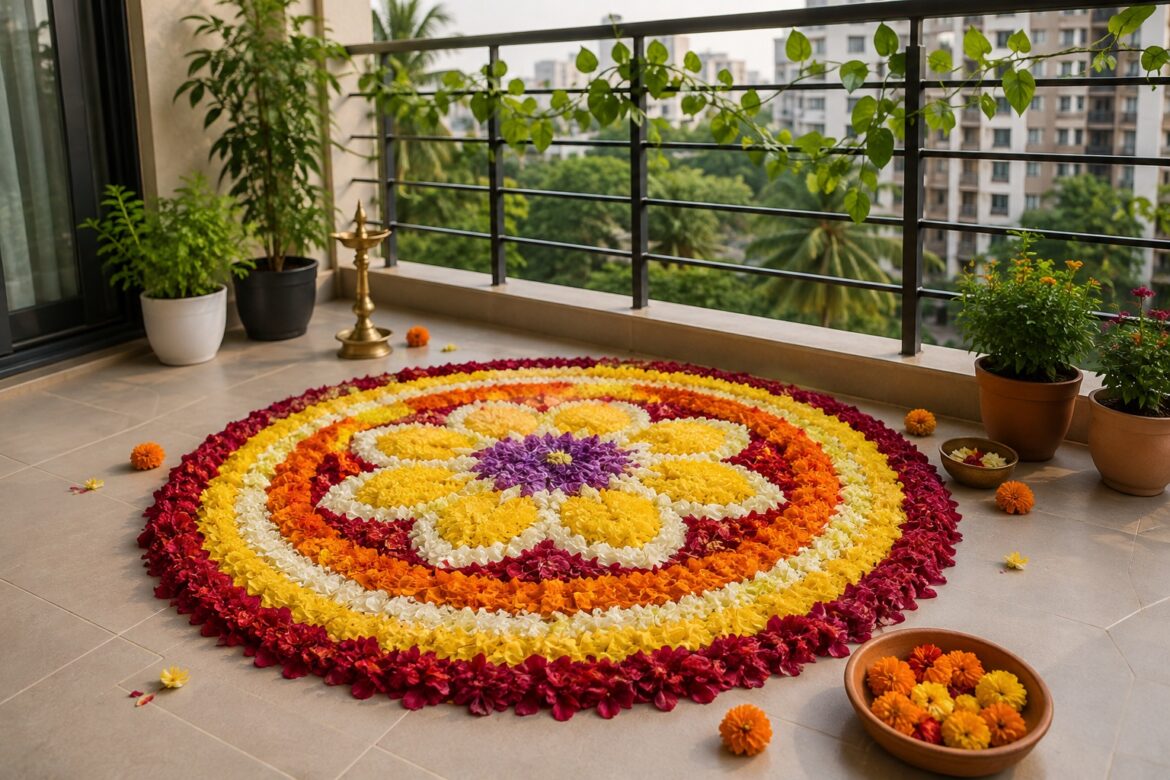
My first pookalam attempt was on the balcony of a second-floor flat in Indiranagar, and by 11 am the marigolds had curled at the edges and the whole thing looked tired before anyone had even come over to see it. Turns out a courtyard-scale tradition doesn’t just shrink down neatly to apartment size — you have to rethink the base, the flower choice, and honestly the whole timeline. I’ve made four of these now, badly at first, and this is the version I’d actually tell a friend to try for Onam 2026.
A pookalam is a decorative floral rangoli created during Onam, Kerala’s harvest festival. Traditionally, families add a new ring of fresh flowers every day from Atham until Thiruvonam, symbolizing prosperity, welcome, and celebration. While traditional pookalams are often made in open courtyards, many families today adapt them for apartments and smaller homes using locally available flowers.
Key Takeaways
- Pookalam-making traditionally starts on Atham (August 16, 2026) and builds daily through Thiruvonam (August 26), growing from one ring to ten.
- Freshness, not size, is what makes an apartment pookalam actually look good — a smaller design that survives four hours beats a large one that’s wilting by lunch.
- Thumba, Chethi, marigold, and Shankupushpam are the traditional core flowers; in Bangalore, marigold and chrysanthemum are the easiest to source fresh and last longest.
- Skip the traditional cow-dung base for an apartment — chalk outline or a wet-flour paste works fine and is far more practical indoors or on tile.
- Buy flowers the same morning, not the night before — this single habit did more for how mine looked than any technique.
Why the Traditional Version Doesn’t Translate Directly to a Flat
A full pookalam in Kerala is laid in an open courtyard, often 4 to 5 feet across, and rebuilt fresh each of the ten days, growing by a ring daily until it peaks at ten rings and ten colours on Thiruvonam. Traditionally it goes down on a base of cow dung, into which the outline is scratched before flowers fill it in. None of that maps cleanly onto a Bangalore balcony or a living room floor — there’s no courtyard, no daily flower market at your doorstep, and cow dung is neither available nor, frankly, something most apartment buildings will love. So the honest version of this project is an adaptation, not a replica, and I think it’s worth saying that upfront rather than pretending otherwise.
What You Actually Need
For a single-day pookalam (which is what most of us are realistically doing, rather than the full ten-day build):
- A flat surface, ideally 2 to 3 feet across — a cleared balcony corner, a spot by the front door, or a coffee table if you’re short on floor space
- Chalk, rice flour, or a wet paste of flour and water for the outline
- Fresh flowers in at least three colours — see the flower guide below
- A pair of scissors and a shallow tray for petal separation (this sounds fussy, but it saves a lot of stem-pulling later)
- A light mist of water in a spray bottle, which buys you a couple of extra hours before things wilt
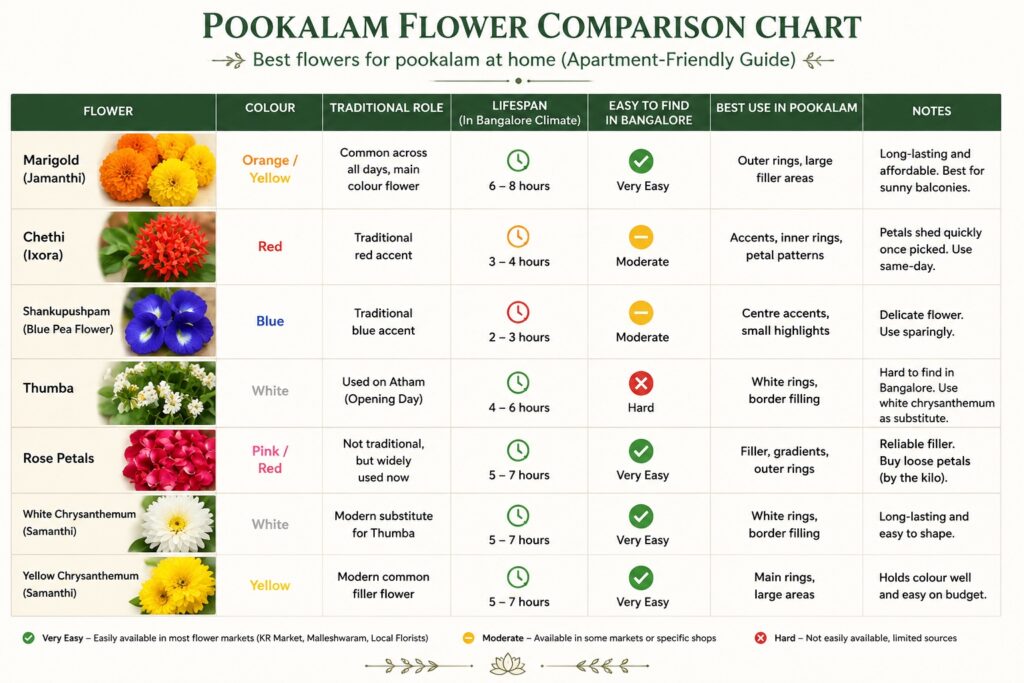
Flowers: What Works and What Doesn’t in Bangalore
| Flower | Traditional Role | How It Held Up for Me |
|---|---|---|
| Marigold (Jamanthi) | Common across all days, big colour payoff | Best performer — lasts 6+ hours even in Bangalore’s midday sun, easy to find fresh at KR Market or Malleswaram |
| Chethi (Ixora) | Traditional red accent | Good colour, but petals shed fast once picked — buy same-day, don’t pre-pluck |
| Shankupushpam (blue pea flower) | Traditional blue accent | Beautiful but delicate — I use this only as a small centre accent now, not for a full ring |
| Thumba | Used on Atham, the opening day | Genuinely hard to source in Bangalore outside Malayali-run flower stalls — I’ve substituted white chrysanthemum with no real loss of effect |
| Rose petals | Not traditional, but common now | Reliable filler, holds colour well, easy to buy loose by the kilo |
If you only buy three things: marigold for gold and orange, a red flower (chethi if you can find it, otherwise a red chrysanthemum), and loose rose petals for volume. That combination alone gets you 80% of the visual effect with the least fuss.
My Actual Process
I start with the outline first, using a rice-flour paste rather than chalk — it wipes up easier if I mess up a curve, and it doesn’t leave a chalky residue on tile the way dry chalk sometimes does. I sketch a simple radial design: a centre circle, then petal shapes fanning outward, nothing more ambitious than that, because intricate patterns take flower quantities I don’t usually have on hand.
Then I separate petals into a shallow tray by colour before I start filling — this is the one step I skipped the first time and regretted. Placing loose flowers one at a time as you go is slow and the design ends up patchy. Pre-sorted petals let you fill a section in minutes rather than working stem by stem.
I fill from the centre outward, and I keep the outer ring in whatever holds up longest — usually marigold — since it’s the part that gets the most sun exposure and dries out first. A light spray of water once it’s done buys a few extra hours, though nothing beats simply timing the whole thing for the morning of the event rather than the night before.
Timing It for Onam 2026
If you want to try the traditional building idea without committing to all ten days, a nice middle ground is a three-stage version: a small single-colour ring on Atham (August 16), a slightly bigger two-colour version around the midpoint, and the full design on Thiruvonam (August 26) itself. I did this last year and it turned a one-off craft project into something that actually felt like it built toward the day, the way the real ten-day version is meant to. And if the ten-day build has you tempted to see it done properly in person, I’ve mapped out exactly which days are worth planning a Kerala trip around for 2026.
FAQ
Do I need cow dung for a pookalam?
No — that’s the traditional rural base, but a wet rice-flour or chalk outline works fine for an apartment or urban home and is far easier to clean up.
How long does a pookalam last?
A well-made one with fresh flowers and an occasional light mist of water holds up for 6 to 8 hours indoors, less in direct sun. Buying flowers the same morning matters more than any preservation trick.
Where can I buy pookalam flowers in Bangalore?
KR Market and Malleswaram’s flower market are the most reliable for marigold, chrysanthemum, and rose petals in bulk. Thumba specifically is harder to find outside Malayali-run stalls — chrysanthemum is a fine substitute.
Do I need a big space to make a pookalam?
No. A 2 to 3 foot design on a balcony corner or coffee table captures the spirit of it without needing courtyard-scale space.

Rohini writes about home styling, beauty, fashion, food, and travel from Bangalore, India — drawing on her background in interior styling and years of testing what actually works in real homes and everyday routines. Every recommendation here comes from something she’s personally tried, not aggregated advice.